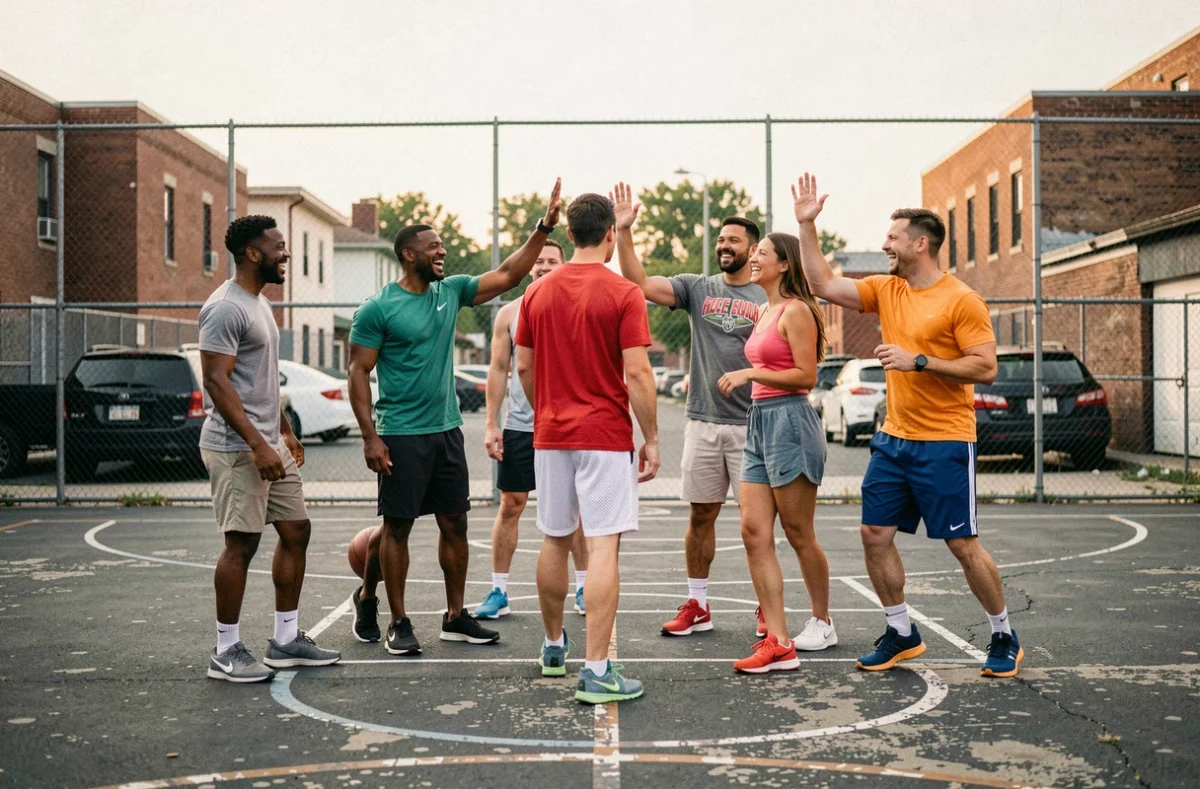
On a futsal pitch in a priority neighborhood, two teams form in less than five minutes. A high school student, a retiree, a newcomer, and a mother share the same jersey. No one asks for a CV. These micro-situations, where the rules of the game replace usual social codes, form the concrete foundation of the link between sports and social integration.
When the sports field compensates for the lack of meeting places
In many municipalities, the multipurpose hall or city stadium remains the only free public space where residents from different backgrounds regularly cross paths. When the media library closes at 6 PM and the social center operates by registration, the gym becomes the last place for spontaneous mixing.
This phenomenon is observed in self-organized practices: football on Sunday mornings, open-access basketball, Nordic walking among neighbors. These informal slots create connections without a facilitator needing to force encounters. The sports framework imposes a minimum of cooperation, communication, and respect for the rules, which is often enough to initiate a relationship.
As detailed in the Info Sport article on social integration, regular sports practice creates a network of contacts that neither work nor neighborhood guarantees, especially for people recently settled in an area.
Professional integration through sports: a system that produces measurable results
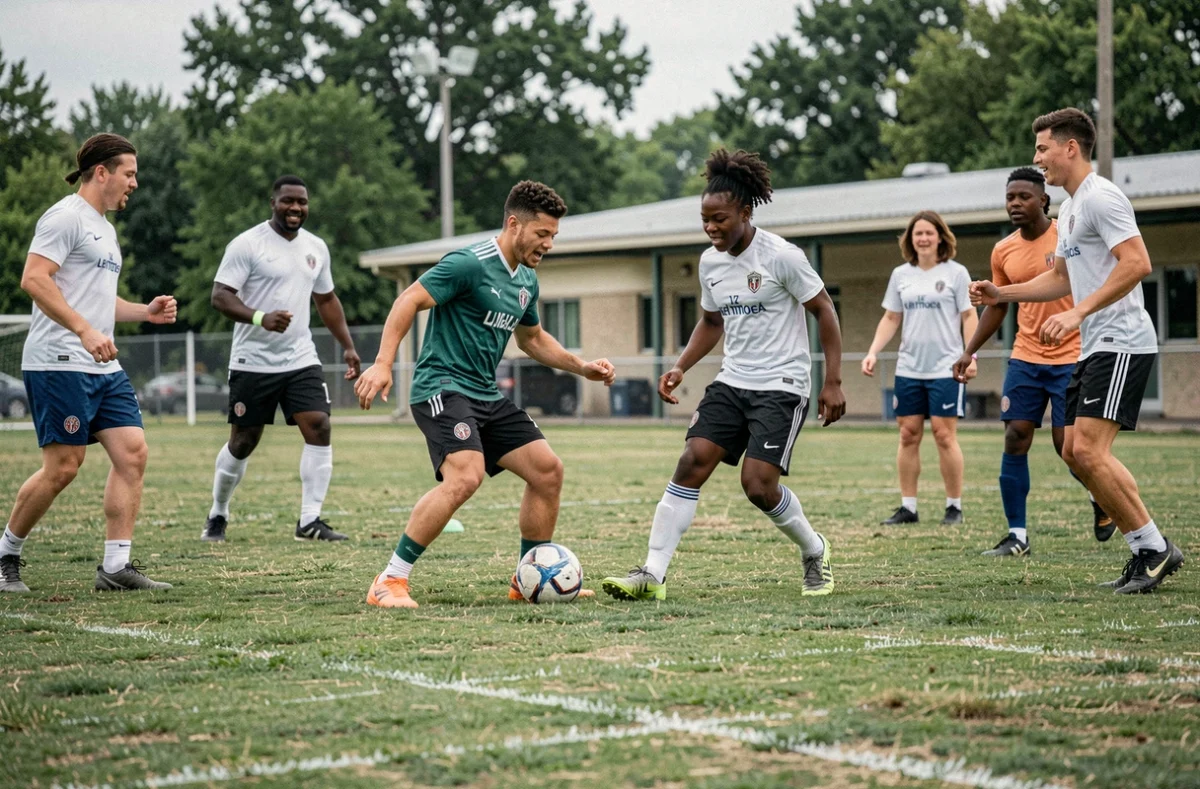
Sports is not limited to neighborhood cohesion. It also serves as a lever for professional integration, with quantified results. In 2025, initiatives involving amateur clubs, professional clubs, and sports federations linked with France Travail enabled many young people to find employment.
The mechanism is not mysterious. A local sports club operates like a small business: it needs volunteers, organizers, and trainers. Young people distanced from employment develop transferable skills (event management, group supervision, logistics) while rebuilding a weekly rhythm.
The sports club as a springboard to employment
- A non-school collective framework, where recognition comes from peers and not from grading
- A gradual increase in responsibility, from refereeing a match to coordinating an inter-neighborhood tournament
- A network of active adults (leaders, sponsors, local elected officials) that the young person would not have encountered otherwise
This extension of living together towards economic autonomy changes the very nature of the associative sports project. We are no longer just talking about social cohesion, but about a structured integration pathway centered around sports practice.
Disability and sports practice: the gap persists despite the visibility of parasports
Paris 2024 has put parasports in the spotlight. The media fallout has been massive. But the reality on the ground tempers the enthusiasm. According to an interview published by Handicap.fr with Marie-Amélie Le Fur in September 2026, 47% of people with disabilities regularly engage in physical activity, compared to 60% of the general population.
The gap is not solely due to motivation. It relates to concrete obstacles: accessibility of facilities, lack of suitable time slots, insufficient training of sports educators. The “Inclusive Club” program attempts to structure large-scale reception, but the central question remains local sustainability. A club can obtain a label, train an educator, adapt a changing room, and then lose its funding the following year.
What hinders the sports inclusion of people with disabilities
Feedback on this point varies by region, but several barriers consistently arise:
- The cost of adapting equipment (sports wheelchairs, sensory equipment), rarely covered by operational grants
- The turnover of trained staff in parasports, often on short contracts or volunteers
- The lack of adapted transport to reach sports facilities, especially in rural areas
Sports inclusion cannot be decreed with a logo on a gym door. It requires a continuous investment in supervision and accessibility of facilities.
Violence and discrimination: the hidden face of sports living together
Talking about social integration through sports without mentioning the violence that occurs would be like describing a school without mentioning bullying. The French Paralympic and Sports Committee (CPSF) proposes to broaden the fight against violence to include all forms of discrimination, not just the sexual violence that has garnered media attention in recent years.
This orientation changes the stance of clubs. They are no longer just asked to report serious cases, but to build a sports environment where every participant feels safe. This involves concrete charters, trained referents, and clear reporting procedures.
Sports supervision and prevention of discrimination
A club that welcomes diverse audiences (youth from priority neighborhoods, people with disabilities, newcomers) finds itself on the front lines of these issues. Training sports educators in conflict management, detecting discriminatory behaviors, and intercultural mediation becomes a prerequisite, not a bonus.
Federations that integrate these modules into their training curricula produce supervisors better equipped to make sports a true space of living together, and not just a place where people sweat side by side.
Sports remains one of the few spaces where people who are completely different agree to play by the same rules. For this dynamic to last, clubs need stable funding and trained human resources, two areas that remain fragile in most associative structures.