
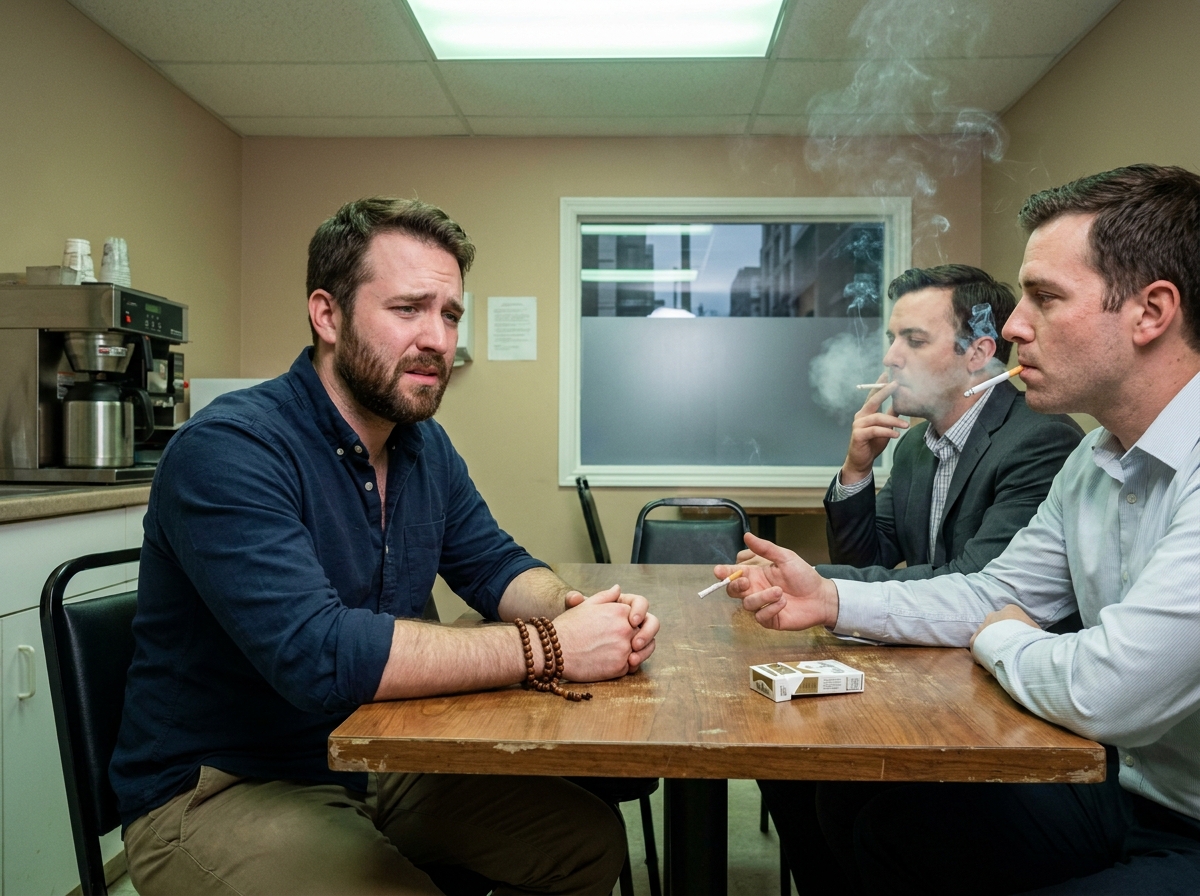
We are on the terrace with colleagues, someone pulls out a pack, and the gesture circulates. We know that smoking contradicts one’s spiritual beliefs, but refusing in this specific context requires an effort that theory does not prepare for. The social pressure surrounding tobacco does not always manifest through a direct invitation: it comes through the atmosphere, the shared ritual, the awkward silence when one declines.
Smoking in a group: the concrete mechanism of social pressure
The scene repeats itself in specific settings. Work breaks, evenings with friends, family gatherings. Tobacco is not offered as a substance; it is offered as a connection. Refusing a cigarette, in the group’s view, equates to refusing the moment of complicity.
This mechanism particularly affects occasional smokers or former smokers. Their position is fragile: they do not define themselves as smokers, but their surroundings remember that they have accepted before. The relapse does not stem from a need for nicotine; it arises from a need for belonging.
In communities where spirituality holds a central place, the tension is even clearer. One carries values that view the body as a vessel to be preserved, yet finds oneself inhaling smoke to avoid creating social discomfort. This contradiction between behavior and belief generates what psychologists call cognitive dissonance related to smoking.
The question also arises with recent devices. An adolescent in a group may be offered a disposable puff without even having the time to reflect on the compatibility of this gesture with their religious or ethical beliefs. The product is small, discreet, and its consumption seems innocuous, making refusal even harder to articulate.
Spiritual values and smoking cessation: why conviction is not enough
Having strong spiritual convictions does not automatically protect against tobacco consumption. One might think that faith or personal ethics acts as a shield, but the reality shows otherwise.
Nicotine acts on the brain’s reward circuit, regardless of beliefs. A person convinced that smoking harms their body and soul can still feel a physical need after a few social cigarettes. Addiction does not negotiate with theology.
The problem complicates when the spiritual community itself is ambiguous on the subject. In some contexts, smoking remains tolerated as long as consumption is discreet. This tacit tolerance deprives the individual of collective support for their cessation. They find themselves alone with their values, facing a group that does not apply them consistently.
Three situations where pressure exceeds conviction
- The family meal where elders smoke openly despite stated religious principles, normalizing the gesture for the younger ones and nullifying the effect of moral discourse
- The professional environment where the smoke break remains the only real moment of informal exchange among colleagues, creating a real social cost for those who do not smoke
- Festive gatherings where tobacco (cigarettes, shisha, disposable products) is an integral part of sociability, and refusing equates to withdrawing from the group
Tobacco-free spaces in France: a lever against social pressure
The regulatory environment alters the occasions for smoking under pressure. The decree n° 2025-582 of June 27, 2025 has extended the smoking ban to several outdoor spaces: public parks and gardens, beaches during the bathing season, waiting areas for transport, and the vicinity of establishments welcoming children.
This extension changes the group dynamic. When smoking in a park exposes one to a sanction, social pressure partially reverses. The non-smoker no longer needs to justify their refusal by their values: the law does it for them. It is an external support that inner conviction alone did not provide.
The situation on terraces remains more nuanced. An open terrace does not fall under the same prohibition as an enclosed and covered place. Thus, one finds themselves in a gray area where social pressure continues to operate freely. Feedback on this point varies depending on establishments and cities.

Concrete strategies to resist smoking without cutting off from the group
Refusing to smoke in a social context should not turn into a sermon. The most effective stance is also the simplest: one can decline without explaining their spiritual reasons, unless in a circle of trust.
Here is what works in practice:
- Prepare a short, neutral phrase before arriving in the social context (“no thanks, I’ve quit” or simply “not for me”), without opening a debate
- Identify an ally in the group, someone who does not smoke either, so as not to be the only one sitting when others step out
- Physically replace the gesture: hold a drink, a phone, change position, to occupy the hands and not leave a void that the cigarette would fill
- After the situation, reconnect with one’s values through a personal ritual (prayer, reading, walking), so that refusal becomes a positive act and not a frustration
The goal is not to convince others of their contradictions. Pointing out the inconsistency of a close one who smokes despite their own spiritual beliefs creates conflict and reinforces isolation. One protects their health and values, not those of the group.
The role of the entourage in smoking cessation
A smoker trying to quit for spiritual reasons needs their surroundings to recognize the difficulty without minimizing it. Saying “it’s just a cigarette” to someone struggling with an addiction while trying to stay true to their principles denies both battles at once.
The communities that best support cessation are those that do not judge relapse but do not trivialize it either. Finding the balance is difficult. It requires honest conversations, not moral injunctions.
Social pressure surrounding tobacco will not disappear with good intentions. Recent bans in French public spaces create a more favorable framework, but the real battle takes place in intimate circles, where the law does not enter and where personal convictions confront the need to belong.